

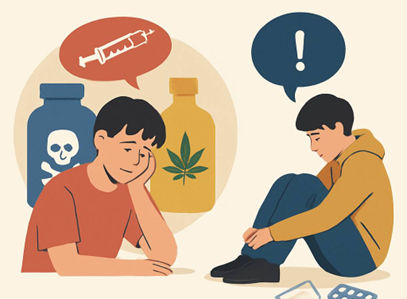
Today, drug addiction is not just a medical or criminal issue.
It's a problem of the breakdown of family relationships, the weakening of values, the inner emptiness of adolescents, and who fills this emptiness.
More than 5,000 minors participated in a large-scale survey conducted by the Institute of Criminology. The results revealed a number of disturbing but very important truths.
🌐 1. Why do young people trust "internet advice"?
Today, minors spend a lot of time online. For them, the internet is not only a means of entertainment, but also a substitute for a "teacher," "friend," and "psychologist."
YouTube, TikTok, Telegram—they have information, but no responsibility.
False content about a new type of "energy" pill is intriguing and sometimes misleading.
If parents don't ask their children, "What did you see online today?"—others will fill the gap.
🗣 2. Lack of open communication between parents and children
According to the survey, one in two minors hasn't talked to their parents about drugs. This is a very serious indicator.
Young people perceive this topic as shameful, taboo, or "punishable." But it is precisely this silence that increases the risk.
Therefore, parents should initiate the conversation themselves. It is important for minors to receive information about drugs and answers to their questions from their parents.
⚠️ 3. The most dangerous result: 38% of teenagers answered: "I don't interfere if my friend uses drugs; it's their business."
The survey showed:
38% of children answered that if a friend takes pills, they don't interfere, don't tell anyone, and consider it "their personal business."
This attitude creates a very favorable environment for the clandestine distribution of drugs.
💊 4. When asked why teenagers start using drugs, the teenagers themselves named specific reasons. Here they are:
1) "It's a trend, a fad."
Social media presents a dangerous habit as "modern."
And young people accept what they consider the norm.
2) "If I take it once, nothing will happen."
This is the most common and most dangerous mistake.
Even one pill:
• shuts down the brain,
• affects the psyche,
• can trigger addiction.
3) Street pressure: the shouts of adult acquaintances on the street.
Many teenagers fall under external pressure:
• "Don't worry, it's just a vitamin."
• "Everyone's tried it, you should try it too."
• "Just taking it once won't make a difference."
This is how a dangerous process begins.
Every year, approximately 0.6 million deaths are related to psychoactive substance use. We need to take action before it's too late. 👪 Practical tips for parents:
✅ Build a trusting relationship
• Start with a simple question: "How are you feeling at school/with friends/at home?" and listen without criticizing.
• Be interested in your child's daily life by asking questions like: "Did something happen that upset you?" • Remember that teenagers often remain silent for fear of reprimand or punishment.
✅ Organize a "mini-training" or game at home
Game: "Fact or Myth"
• Prepare 5-7 cards about drugs/psychotropic substances (e.g.: "If I drink once, nothing will happen," "If all my friends have tried it, it's normal," "Everything they show in commercials is true," etc.).
• Discuss with your child: is it fact or myth? - and discuss why you think so. • Finally, ask, "What can we do if we encounter this situation?" – this will help the child formulate the appropriate response. Family Mini-Workshop: "We Are a Team"
• Set aside 45 minutes to watch a short video or infographic together about the dangers of psychotropic substances (download in advance).
• Then, the parent and child write a separate text: "What worries me?", "What will help me?", "Who can I turn to?" Then read it together.
• Finally, establish a "family rule": if someone's friend or acquaintance is in a dangerous situation, we will tell them and take action.
• Suggest: "If you notice something suspicious about your friend, we will agree on a sign (code word) to let me know."
✅ Give a short "reflection assignment" at home
• Ask the child to write down the following questions throughout the week:
– "When have I felt lonely?"
– "When did I feel pressured?"
– "When did I see a drug commercial?"
• At the end of the week, discuss together:
– What did you feel?
– What did you do? – What would you like to do differently?
• Parents do the same: "When was I too busy?", "When did I notice my child was anxious?"
This method strengthens the psyche and shows the teenager, "I'm in this too."